
About Me
Hello World, I'm Ani!Just like little seeds need water and sunlight to germinate, I love serving as the bridge between business needs and technology.As a seasoned professional, I have completely given my heart over to the process of taking an idea from a mere thought to a live product, leading to a track record of developing cutting-edge systems and delivering successful projects.Over the years, I've worked across different industries and technologies, learning that the best solutions don't always come from adding more features or choosing the most elaborate approach.Sometimes, they come from asking better questions, challenging assumptions, and getting to the root of the problem.More recently, I've become particularly interested in how AI and emerging technologies can improve the way businesses operate, especially when paired with sound business analysis and thoughtful implementation.For me, the beauty of this profession lies in the endless opportunities to learn, question, and reimagine what's possible. If there's a process to improve, a problem to untangle, or a better way of doing things, I'm all in!
Skills
Jira | Wrike | Confluence | Salesforce | Power BI | SQL | Visio | Lucidchart | Miro | Figma
Requirements Gathering & Documentation
User Stories & Acceptance Criteria
Stakeholder Engagement
Backlog Refinement
QA & UAT
Product Discovery
Process Mapping & Re-engineering
Data Analysis
API & Data Requirements
AI Integration Requirements
Workflow Automation
Featured Projects
Templatizing Notifications
Standardized transaction notifications for a CRM platform—boosting transparency, reducing manual effort, and ensuring the right updates reach the right people at the right time.
Cruise Booking – Payments Page
Designed a seamless payment experience for cruise travelers—reducing support dependency, enhancing security, and enabling flexible payment options for a frictionless booking process.
Retail Reporting Application Enhancement
Enhanced retail reporting for high-ticket sales—automating insights, strengthening fraud prevention, and streamlining approval workflows for smarter, faster decision-making.
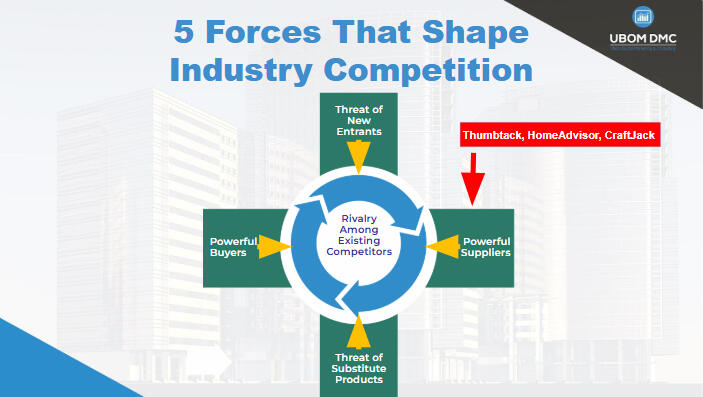
Digital Transformation & Automation
Implemented lead generation & conversion systems for home improvement contractors using automated lead tracking, remarketing, and drip campaigns.
Professional Certifications
Professional Scrum Product Owner I (PSPO I), Scrum.org
In Progress, expected Dec 2026
Templatizing Notifications
Redesigning Real Estate Transaction Notifications for Improved Transparency
Overview
In the real estate industry, transparency and timely communication are crucial to ensuring smooth transactions.I led the initiative to redesign and templatize email notifications for a real estate CRM system, used by brokers, agents, and clients to manage end-to-end real estate transactions.The project aimed to simplify notification management, enhance clarity, and align emails with business logic while reducing operational inefficiencies in onboarding new brokerages.
Business Challenge
The existing notification system lacked standardization, leading to inconsistencies in messaging, missed updates, and confusion among users. Over 50 different notifications per transaction type existed, and each had to be manually updated in the backend when onboarding a new brokerage. This created:
Operational inefficiencies – Manual updates for each transaction type led to significant delays and effort overhead.
Inconsistent messaging – Notifications were not standardized, resulting in varying formats and structure, making it difficult for users to extract key information quickly.
Lack of clarity in business logic – Some notifications did not properly align with transaction triggers, leading to miscommunication among brokers, agents, and clients.
Limited customization – The static templates made it difficult to tailor notifications based on different user roles and preferences.
Solutions Approach
I spearheaded a comprehensive redesign aimed at streamlining processes, improving message clarity, and ensuring alignment with business operations. This approach focused on engaging with stakeholders, mapping existing workflows and standardizing notification templates - all within an Agile framework:
1. Stakeholder Engagement & Business Logic Validation
Conducted interviews with SMEs to understand notification context, recipients, and triggers.
Collaborated with stakeholders to identify opportunities to introduce new notifications that improved transaction transparency.
2. Business Process Analysis & Documentation
Executed a full transaction workflow to document all current notifications in the system.
Mapped notifications to business processes, identifying gaps in coverage and opportunities for improvement.
3. Notification Structuring & Standardization
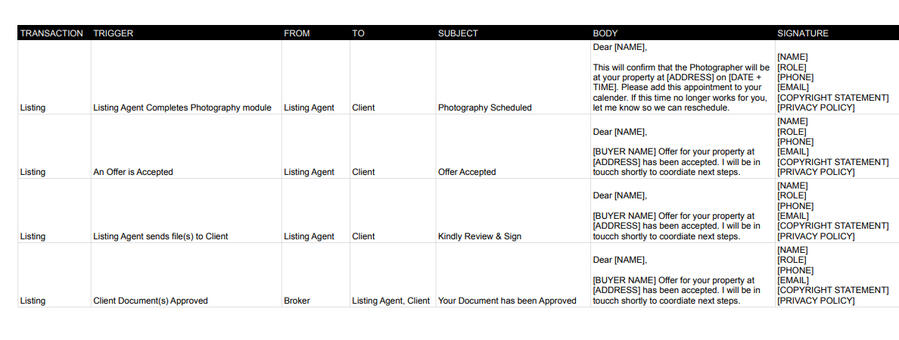
Compiled all notifications in an Excel sheet, categorizing by User Type, Trigger, Subject, Body, and Signature.
Created a standardized format that became the "Notifications Bible" – a key reference for Development and QA teams.
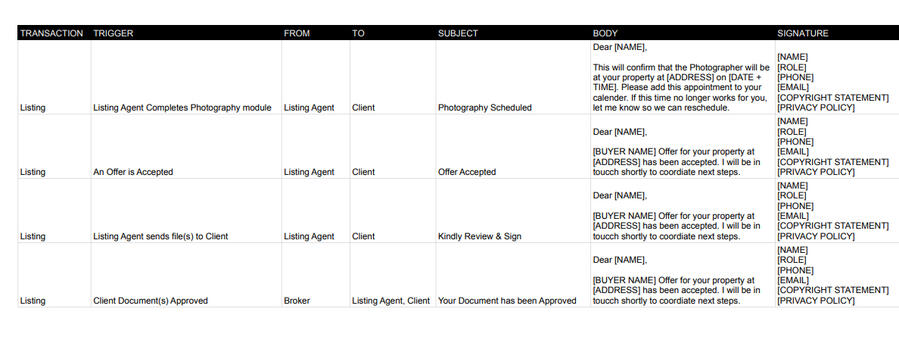
Sample Notifications Mapping Table
4. UI/UX & Content Enhancement
Designed dynamic email templates for each user type in collaboration with UI/UX teams (Figma prototypes).
Worked with a third-party copywriter and legal team to ensure the language was user-friendly and compliant with regulations.
5. Agile Execution & Implementation
Managed the development lifecycle using an Agile framework, ensuring smooth progress through Dev, QA, and UAT phases.
Facilitated backlog refinement, sprint planning, and ticket management, ensuring notifications met the definition of done.
Skills
✅ Business Process Analysis – Identified inefficiencies in the existing notification system and proposed a structured solution.✅ Stakeholder Engagement – Led discussions with agents, brokers, and product managers to gather insights and validate requirements.✅ Requirements Documentation – Created detailed functional specifications to guide the development team.✅ UI/UX Design – Standardized notification templates and worked with designers for better readability.✅ UAT & Quality Assurance – Designed test cases and facilitated UAT to ensure seamless implementation.
Key Outcomes
📌 Reduced notification management overhead, cutting the time required to onboard a new brokerage by 40%.📌 Standardized, aesthetically appealing emails led to higher readability and user engagement.📌 Introduced a dynamic template system, eliminating the need for manual backend updates and decreasing developer workload for notification changes by 50%.📌 Validated all 50+ notification triggers, ensuring 100% accuracy in transaction-related updates.📌 Worked with legal teams to review 100% of notifications, ensuring compliance and mitigating regulatory risks.📌 New, visually optimized templates improved readability, and role-based notifications ensured that brokers, agents, and clients received only relevant updates, reducing email fatigue.
Conclusion
Clarity drives action and in real estate transactions, where every second counts, a missed or confusing notification can mean delays, frustration, or even lost deals, I quickly realized that improving email notifications wasn’t just about making them look better—it was about ensuring that the right people received the right information at the right time, allowing deals to move forward smoothly.I also love to highlight this project as it demonstrates my ability to take ownership of a critical application component, especially in a new domain.By applying a structured business analysis approach, and asking the right questions to truly understand how real estate transactions work—not just from a technical standpoint, but from the day-to-day experiences of brokers, agents, and clients, I was able to balance business needs, user experience, and technical feasibility, all while working with a diverse group of stakeholders.
Cruise Booking – Payments Page
Streamlining Payment Management for Cruise Bookings
Overview
I played a critical role in designing a comprehensive Payments Page for a cruise booking platform, addressing significant inefficiencies in the payment process.Passengers had no dedicated view to track balances, past payments, or make new transactions without customer support intervention.
Business Challenge
The cruise booking platform lacked a structured payment management system, leading to increased customer frustration and an overburdened support team.The existing process was cumbersome, requiring users to call customer support to track balances, make payments, and resolve disputes.
Lack of Payment Visibility – Users had no single place to track balances and view previous payments.
No Self-Service Options – Guests and registered users needed assistance for simple payment actions.
Fragmented Payment Process – No standardized flow for logging in, entering billing details, and processing payments.
Inability to Split Payments – Guest and registered users were forced into a one-size-fits-all process, ignoring their distinct needs.
Compliance & Security – The system needed to be PCI-DSS compliant for secure transaction handling.
Solutions Approach
I implemented a solution that catered to both guest users and registered passengers. Guest users needed a frictionless, one-time payment experience, while registered users required features such as installment payments, saved billing details, and transaction tracking.
1. Requirements Gathering & Stakeholder Engagement
Conducted discussions with product owners, SMEs, and engineers to define requirements.
Collaborated with UX/UI teams to define a payment flow that balances security and usability.
Researched payment gateway integrations (Stripe, PayPal, Authorize.Net) to ensure compliance and global payment acceptance.
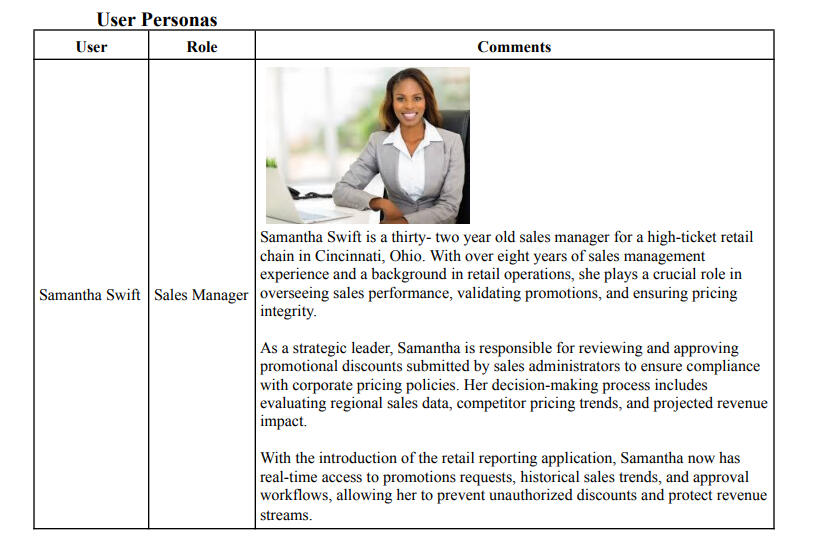
2. User Persona Development
Designed flows catering to both logged-in users (who needed split payment and tracking features) and guest users (who required a simplified process).
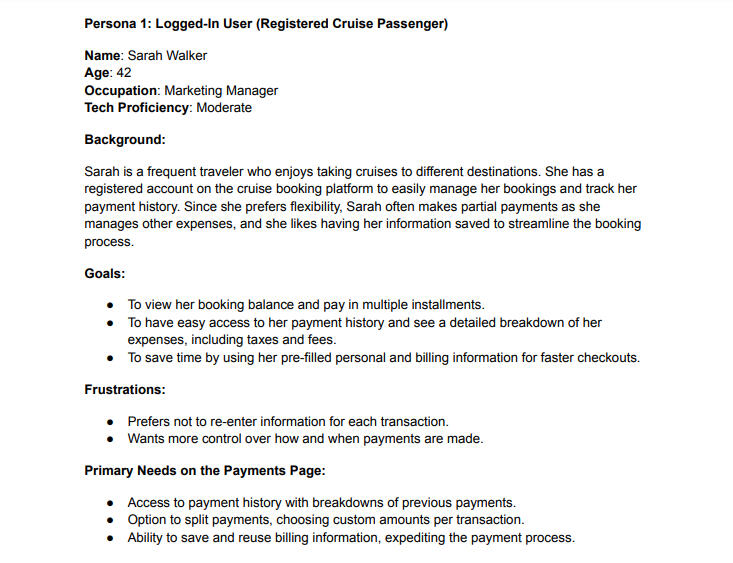
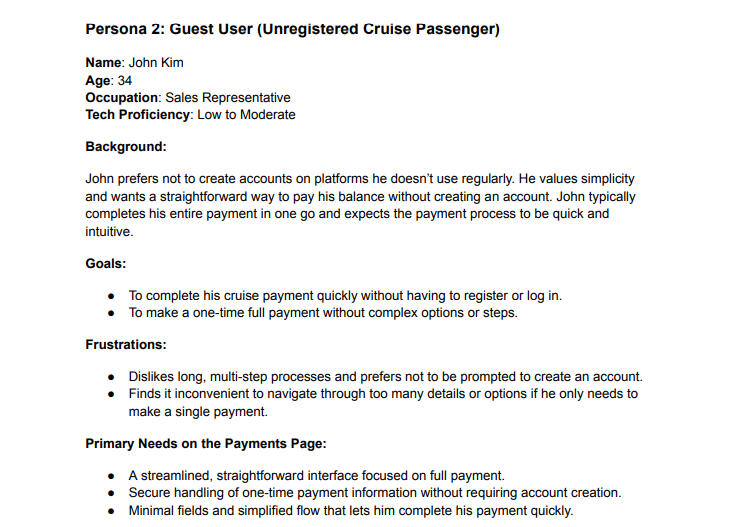
Sample Detailed User Persona
3. User Story Development
Created structured user stories and acceptance criteria to define the payment experience.
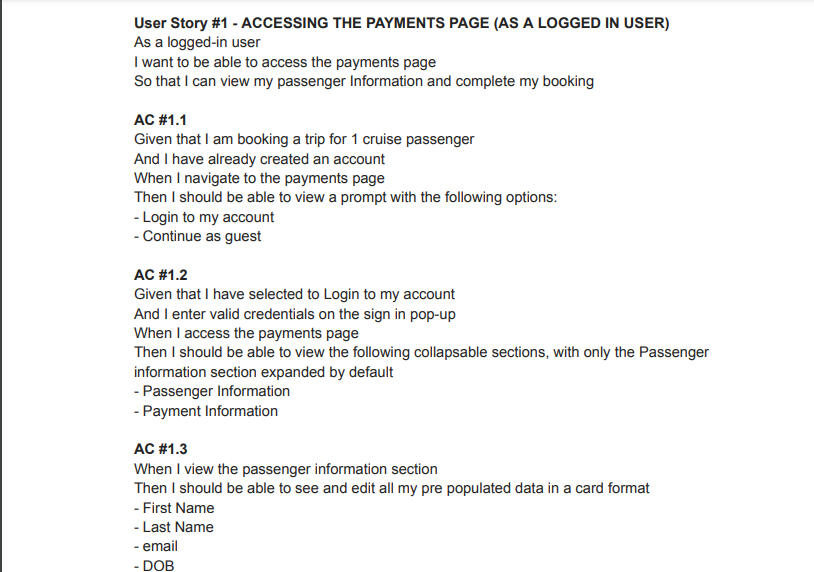
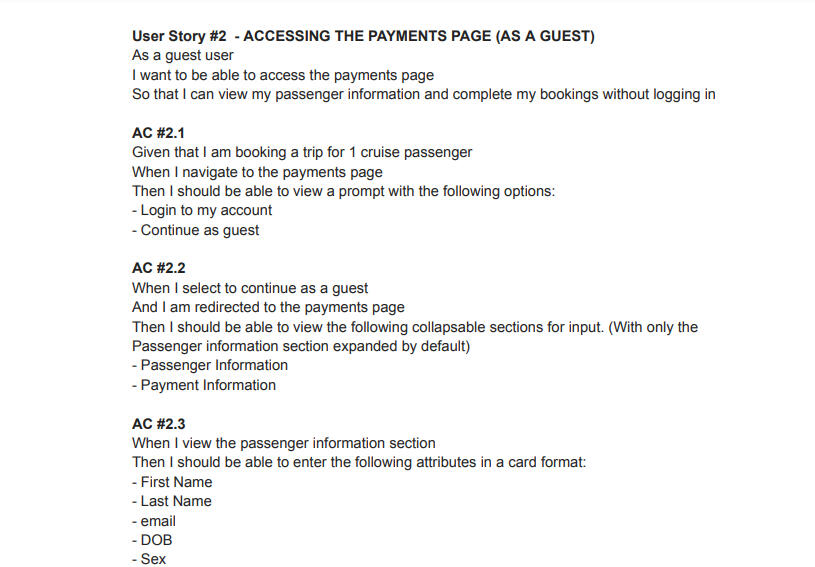
Sample User Story + Acceptance Criteria
4. Process Flow Optimization
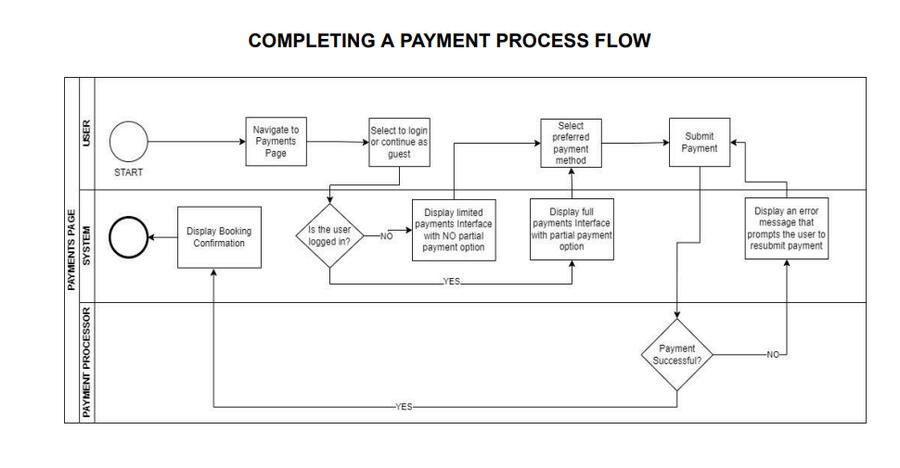
Defined a structured payment journey: Login / Guest Checkout → Payment Entry → Payment Confirmation → Receipt Generation
Developed a responsive UI wireframe ensuring cross-device accessibility.
Established error handling workflows to guide users through failed payments.
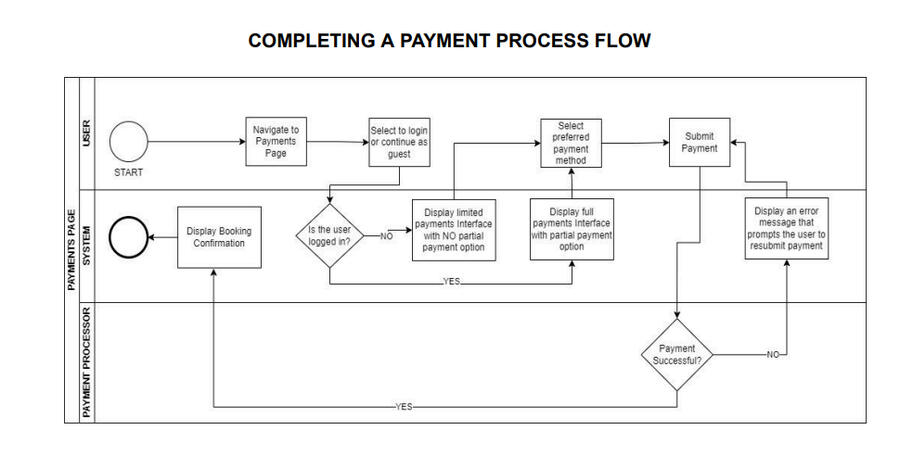
Sample Process Flow Diagram Depicting a User Completing a Payment
Skills
✅ Requirements Gathering & Analysis – Identified business needs and translated them into functional requirements, using benchmarking as a key technique to validate assumptions.✅ User Story & Acceptance Criteria Writing – Developed detailed user stories and acceptance criteria, ensuring that all functional and non-functional requirements were met.✅ Process Flow Design – Created structured workflows to outline the payment journey across different user types.✅ API Integration – Defined API requirements for third-party payment gateway integration.
Key Outcomes
📌 Decreased payment-related customer service requests by 25% as users could now independently track balances, view payment history, and complete transactions without assistance.📌 Reduced average payment completion time from 3 minutes to 1.5 minutes, increasing successful transactions by 18% due to a more intuitive checkout experience.📌 Flexible Payment Options – 70% of registered users opted for installment payments, leading to a 22% decrease in abandoned bookings and improved user satisfaction scores.📌 Secure payment handling ensured compliance with financial standards.
Conclusion
The Payments Page redesign successfully modernized and streamlined the payment experience for cruise travelers. By applying benchmarking insights, process optimization techniques, and API integrations, the solution reduced customer support dependency while improving payment flexibility and security.This project demonstrated my ability to leverage research-driven insights to improve product functionality, and translate business challenges into structured technical requirements.
Retail Reporting Application Enhancement
Fraud Detection & Process Re-engineering for Revenue Optimization
Overview
I played a pivotal role in enhancing an in-house retail reporting application. The application initially had a lean structure with three core features: Sales, Promotions, and Reports.Growing client demands led to the introduction of new functionalities, including Stores, and Products.My most significant contribution came from identifying a critical loophole in the Promotions feature, leading to a re-engineered process that saved our clients up to a quarter of a million dollars annually.
Business Challenge
The client’s revenue tracking process relied on overnight batch uploads, where retail sales data was manually uploaded as flat files by the database team. This outdated approach led to delays, data inconsistencies, and a lack of real-time visibility into sales transactions.Over time, the client identified a persistent 3% gap in actual vs. projected revenue, which remained unresolved for two consecutive quarters.
Solutions Approach
To address the critical gaps in revenue accuracy, fraud prevention, and operational inefficiencies, I led efforts to enhance fraud detection, modernize data processing, and streamline reporting:
1. Process Flow Analysis
Conducted a deep dive into the process flow of each feature, reviewing workflows and use cases.